
Island notes
Don Det
Si Phan Don · Mekong · old railway
An island field guide to Si Phan Don, the old railway, Don Khon, Mekong travel and the slower logic of Southern Laos.
- 01Si Phan Don is a river system, not four thousand identical islands
- 02The old railway explains why Don Det and Don Khon are linked
- 03Don Det and Don Khon work better together than apart
- 04Sunrise, sunset and distance from the pier shape the stay
01 · Read the islands
Si Phan Don is a river system, not four thousand identical islands
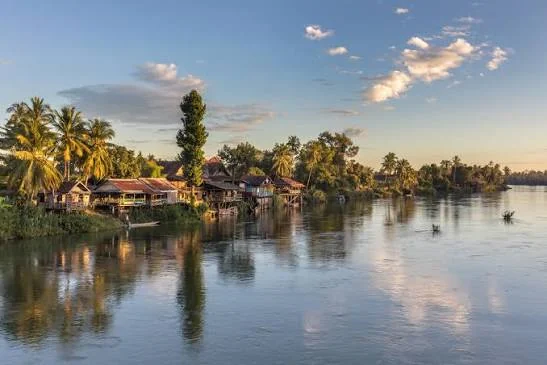
Si Phan Don is a broad riverine landscape in Champasak where the Mekong divides around islands, islets, seasonal sandbars and channels before reaching the major falls farther south. Don Det is one of the best-known traveller bases, but it is only one part of that system.
The useful shift is to stop treating Don Det as the attraction itself. The island provides beds, food, bicycles and boats; the larger experience comes from the relationship between Don Det, Don Khon, the Mekong channels and the waterfalls that historically made this stretch of river difficult to navigate.
02 · A railway built around a waterfall
The old railway explains why Don Det and Don Khon are linked
During the French colonial period, a narrow-gauge railway connected Don Det and Don Khon. It was built to move goods and boats around the impassable Khone Falls section of the Mekong rather than through it.
The remains of that infrastructure—especially the bridge between the islands and traces of the old line—give the landscape a historical logic. What now feels like an easy bicycle crossing once belonged to an ambitious transport solution for a river that refused to become a simple navigation route.
03 · One bicycle chapter
Don Det and Don Khon work better together than apart
A bicycle is the natural way to connect the two islands. Don Det supplies the social base and easy accommodation; Don Khon opens quieter village roads, old railway traces and access toward Li Phi–Somphamit and other river landscapes.
Recent island guides consistently treat the crossing as a full-day rhythm rather than a race. Ride early, stop when the landscape changes, leave time for food and return before darkness turns simple rural tracks into a navigation problem.


04 · Choosing your side
Sunrise, sunset and distance from the pier shape the stay
The northern arrival area is practical for boats, food, tickets and a short stay. Farther around the island, the atmosphere becomes quieter. The sunrise and sunset sides offer different light and social rhythms, while the southern end shortens the ride toward Don Khon.
This is one of those places where location matters more than room polish. A simple bungalow with the right river edge, hammock and distance from the busiest bars may fit the trip better than a more finished room in the wrong part of the island.
05 · The river decides
The Mekong is scenery, transport and the main safety decision
Boats, kayaking and river-edge swimming make the Mekong central to the Don Det experience. The same river also carries strong current, changing depth and debris, particularly when seasonal water rises.
Use a life jacket for organised water activities, protect documents and electronics, and ask how current conditions alter the planned route. Calm-looking water beside an island does not automatically mean safe swimming, and the major rapids and falls farther south are not casual bathing areas.
06 · Where the Mekong breaks
The waterfalls deserve separate routes, not one overloaded day
Li Phi–Somphamit fits naturally into a Don Khon bicycle day. Khone Phapheng, the largest fall complex in the area, sits on a different route and usually requires a mainland transfer or organised excursion.
Treating every waterfall as one checklist weakens the geography. One belongs to the island rhythm; the other reveals the scale of the Mekong as it drops and divides before Cambodia. Choose the route that fits the day rather than forcing both into one timetable.
07 · Island limits
Bring cash, save the boat details and respect the final connection
Don Det has plenty of traveller services, but it remains an island with more limited banking, healthcare and transport backup than Pakse. Arrive with enough kip for accommodation, meals, tickets and an unexpected private transfer rather than depending on one payment method.
For onward travel toward Cambodia or back north, confirm the complete sequence—boat, road vehicle, border procedure and operator—before departure. A ticket sold as one journey can still involve several handovers, so avoid attaching a tight international connection to the same day.
08 · Let the island work
Stay until Don Det stops feeling like transit
One night mostly proves that you arrived. Two nights allow a Don Khon day. Three or four nights make room for another river journey, a slower island loop, weather changes and the unplanned time that gives Si Phan Don its reputation for slowing travellers down.
That does not mean doing nothing by rule. It means giving the island enough space that one sunset, a bicycle road or a long breakfast does not feel like time stolen from an itinerary.
Boat times, river conditions, border procedures and island services can change. Confirm anything attached to a fixed departure, the Cambodia crossing or water safety before relying on it.
Sources & further reading
BACK TO THE CITY
Start exploring Don Det
Keep these notes as context, then return to Don Det for landmarks, addresses and the practical side of the stay.