
City notes
Luang Prabang
Mekong · Nam Khan · royal old town
A city field guide to the royal past, living Buddhist traditions, UNESCO old town, river geography and everyday rhythm of Luang Prabang.
- 01The peninsula explains why Luang Prabang feels different
- 02Xieng Thong became a royal capital long before it became a heritage town
- 03The World Heritage value is the whole townscape, not one monument
- 04Wat Xieng Thong is the landmark; the smaller monasteries explain the city
01 · Read the shape first
The peninsula explains why Luang Prabang feels different
The historic centre sits between the Mekong and the Nam Khan beneath Phousi Hill. That geography compresses royal buildings, monasteries, old village lanes, river edges and later colonial streets into a small area that rewards walking rather than constant transport.
Wikivoyage and Wikitravel both describe the town through this same physical contrast: traditional Lao wooden houses and temple roofs sitting beside European-era buildings, with mountains and rivers always close to the street. Start by learning that shape and the old town becomes much easier to read.
02 · Before the postcards
Xieng Thong became a royal capital long before it became a heritage town
The city was historically known as Xieng Thong and became the capital of Lan Xang under Fa Ngum in the fourteenth century. The Prabang Buddha image became tied to royal legitimacy and eventually gave the city the name by which it is known today.
Political power later shifted toward Vientiane, but Luang Prabang retained an unusually strong royal and religious identity. Under the French protectorate it again served as a royal centre, and that layered history helps explain why the former palace, monasteries and ceremonial life still sit so close together in the modern city.
03 · Why UNESCO matters here
The World Heritage value is the whole townscape, not one monument
Luang Prabang was inscribed on the UNESCO World Heritage List in 1995 under criteria ii, iv and v. UNESCO highlights the unusually coherent fusion of traditional Lao urban architecture, religious buildings, vernacular wooden houses and nineteenth- and twentieth-century colonial structures.
That distinction matters for a visitor because the heritage is carried by streets, houses, river edges, wetlands, monasteries and old village patterns together. Recent UNESCO conservation work also shows that this living fabric is under pressure from tourism, development, infrastructure and the long-term maintenance of historic wooden buildings. Respecting the city means paying attention to the ordinary fabric between the famous stops.


04 · More than a temple checklist
Wat Xieng Thong is the landmark; the smaller monasteries explain the city
Wat Xieng Thong is one of the clearest expressions of Luang Prabang religious architecture and remains one of the city’s essential historic sites. But UNESCO’s description of the old town is broader: traditional villages developed around their own religious foundations, creating a dense network of monasteries across the peninsula.
That means the strongest temple walk is not necessarily the one with the highest number of tickets. Use Wat Xieng Thong, Wat Mai and the major sites as anchors, then leave room for smaller compounds, shaded courtyards and the changing relationship between monastery walls and neighbourhood streets.
05 · Morning belongs to the city
The alms round is a religious practice before it is a photograph
The morning alms round remains one of Luang Prabang’s most visible Buddhist practices. Monks move through neighbourhood streets at dawn while residents offer food. Both open travel guides and the official Luang Prabang tourism office warn, directly or indirectly, that visitors should treat the ritual with restraint rather than turn it into a staged attraction.
If you do not understand how to participate, watching quietly from a respectful distance is better than joining badly. Avoid flash, do not block the procession and do not push a camera into someone’s face. Afterwards, the morning market offers a completely different view of the city: produce, herbs, fish and daily food rather than souvenir commerce.
06 · Eat the northern chapter
Luang Prabang has a food identity strong enough to deserve its own route
The city is associated with dishes and ingredients that give northern Lao cooking a distinct local accent. Or lam, Luang Prabang sausage, mok pa, kaipen river weed and jeow bong appear repeatedly in local and collaborative guides and are more useful to remember than a generic list of “Lao food”.
Markets are the best place to see the ingredients before meeting them on a menu. Build at least one meal around local dishes rather than defaulting to the large café and international restaurant scene that has grown with tourism.
07 · The railway changed the approach
Arriving is faster now; the old town should still be explored slowly
The Laos–China Railway radically shortened the journey between Vientiane, Vang Vieng and Luang Prabang. The railway station sits well outside the historic centre, so the fast train does not remove the final transfer into town. Tickets and departure procedures also deserve advance planning rather than a last-minute assumption.
Once inside the old town, the logic changes. Much of the peninsula is walkable and short rides can be handled by bicycle, tuk-tuk or local transport. Save the motorised planning for the station, airport and larger excursions instead of using it to jump between every temple and café.
08 · Give the city room
Three mornings tell you more than one packed sightseeing day
Luang Prabang can be crossed quickly, which makes it easy to over-schedule. A better city stay leaves one morning for the peninsula, one for markets and neighbourhood temples, and enough unplanned time to return to the river, a museum or a street that looked different at another hour.
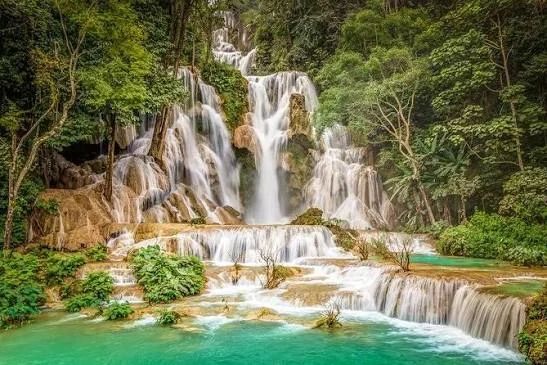
Kuang Si Falls, Pak Ou and the wider province are strong excursions, but they should not consume every day. The old town is the reason Luang Prabang is a World Heritage city; give it enough time before treating the city only as a launch point for waterfalls and river trips.
Opening hours, transport arrangements, river conditions, train availability and entrance fees can change. Treat practical details as a planning framework and confirm time-sensitive information locally or with the relevant official source.
Sources & further reading
BACK TO THE CITY
Start exploring Luang Prabang
Keep these notes as context, then return to Luang Prabang for landmarks, addresses and the practical side of the stay.