
City notes
Pakse
Mekong confluence · Bolaven · Champasak
A city field guide to the Mekong confluence, the Bolaven Plateau, Champasak heritage and the practical role Pakse plays in Southern Laos.
- 01Pakse begins where the Xe Don meets the Mekong
- 02The streets are younger than the landscape around them
- 03The Bolaven Plateau starts with altitude, coffee and falling water
- 04Vat Phou turns the southern road into a history lesson
01 · Read the city
Pakse begins where the Xe Don meets the Mekong
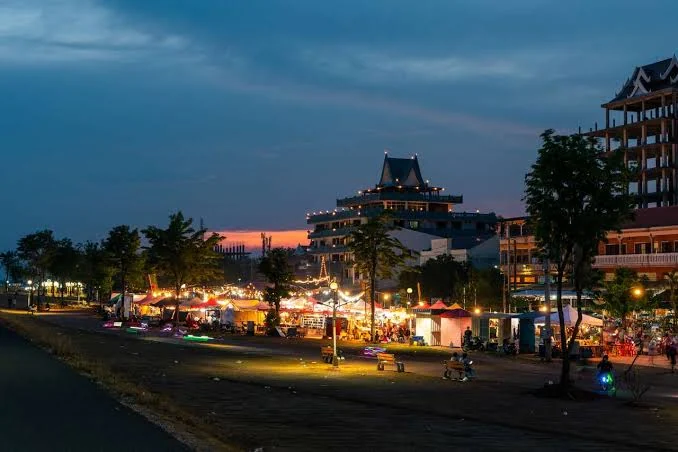
The name Pakse is tied to the mouth of the river, and the geography still explains the city better than a list of sights. The centre sits around the meeting of the Xe Don and Mekong, with bridges, markets, temple streets and transport roads spreading outward from that confluence.
That position made Pakse an administrative and trading centre for Champasak and still makes it the most useful southern base for travellers. The city is compact enough to understand quickly, but the routes leaving it point toward very different landscapes.
02 · A relatively young city
The streets are younger than the landscape around them
French authorities established an administrative post at Pakse in 1905. The city later served as the capital of the Kingdom of Champasak until the formation of the Kingdom of Laos in 1946, leaving a layer of twentieth-century administrative history beside a much older southern cultural landscape.
That contrast is useful when reading the region. Pakse itself is a modern hub; the deeper historical chapter sits around Champasak and Vat Phou, where Khmer sacred geography reaches back many centuries. The unfinished Champasak Palace, now used as a hotel, is one visible reminder that the twentieth-century political story also passed through the city.
03 · The road east
The Bolaven Plateau starts with altitude, coffee and falling water
East of Pakse, the road climbs onto the Bolaven Plateau, a highland landscape associated with cooler air, fertile soils, coffee farms, villages and some of Southern Laos’s best-known waterfalls. Travelfish and long-form road guides consistently frame Pakse as the natural launch point for the plateau rather than the attraction itself.
The classic small and large loops deserve multiple days. Tad Fane, Tad Yuang, Paksong and Tad Lo are not best compressed into one frantic photo run. Road surface, rain, daylight and the time spent at coffee farms or villages matter as much as the number of stops.


04 · The road to older Champasak
Vat Phou turns the southern road into a history lesson
South of Pakse, Champasak leads toward Vat Phou and its associated ancient settlements. UNESCO inscribed the wider Champasak cultural landscape in 2001, recognising far more than an isolated temple: the relationship between mountain, water, settlements, processional routes and Khmer religious architecture is central to the site.
That makes Champasak a different kind of excursion from the Bolaven Plateau. One route is shaped by altitude, waterfalls and agriculture; the other by the Mekong, sacred geography and archaeology. Giving them separate days makes both easier to understand.
05 · What belongs to Pakse itself
Markets, temple streets and the river make the city worth one unhurried day
Dao Heuang market is one of the clearest places to see Pakse functioning as a regional hub: produce, household goods, prepared food and daily trade matter more here than souvenir staging. Travelfish also points toward the old French-quarter streets, cafés and Wat Luang as part of the city’s everyday texture.
The city is best explored without trying to manufacture a monument list. Walk a few central streets, eat in the market or a local noodle shop, cross the river when the light is good and let the Mekong explain why Pakse grew where it did.
06 · A southern hinge
Road and air matter more here than rail
Pakse sits outside the Laos–China Railway corridor. Long-distance buses and minivans connect the city with the rest of Laos, while Pakse International Airport provides the fastest alternative for selected domestic and regional journeys.
That makes timing important. If the next step is an important flight, border crossing or overnight bus, return from the plateau or Champasak with margin. A road day that looks short can expand with weather, mechanical issues or a delayed local transfer.
07 · Choosing the base
Stay for the road you are taking next
For one night, a central guesthouse close to food, rental shops and onward transport is usually the easiest choice. For a longer pause, a quieter riverside or cross-river property can make more sense if you do not need to collect a scooter or catch an early departure.
The useful question is not which neighbourhood is best in the abstract. It is what needs to happen tomorrow morning: airport, bus station, motorbike briefing, Champasak departure or a slow day in town.
08 · Setting the pace
Pakse needs two nights; Southern Laos needs much longer
One night works as transit. Two nights allow the city to become a place rather than a waiting room. After that, count the Bolaven Plateau, Champasak and Si Phan Don as separate travel chapters instead of pretending every road belongs inside a Pakse stay.
A strong southern route often uses Pakse twice: once to organise the road and once to reset after it. That second night can be more useful than squeezing another waterfall or island into a timetable that is already full.
Flight schedules, road conditions, waterfall access and local transport arrangements can change. Use the city notes to understand how Pakse fits the region, then confirm anything attached to a fixed departure or weather-sensitive road.
Sources & further reading
BACK TO THE CITY
Start exploring Pakse
Keep these notes as context, then return to Pakse for landmarks, addresses and the practical side of the stay.