
City notes
Thakhek
Mekong · limestone · Hin Nam No
A city field guide to the Mekong, the Thakhek Loop, Khammouane karst and the cave journeys that begin beyond town.
- 01A Mekong town before it became a loop town
- 02The loop is a journey, not a collection of stops
- 03Limestone explains why Khammouane feels unlike the rest of the route
- 04Hin Nam No changes the scale of the region
01 · Read the city
A Mekong town before it became a loop town
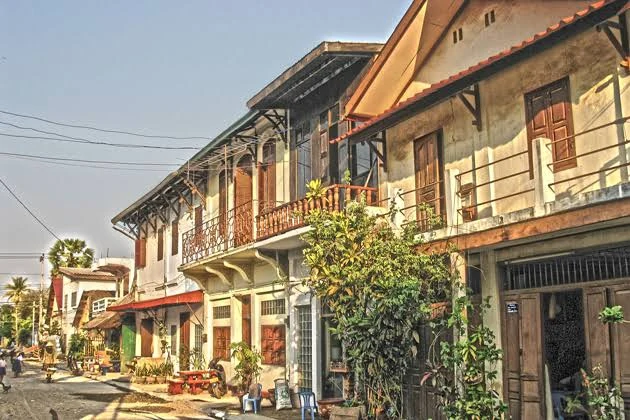
Thakhek is the capital of Khammouane Province, facing Nakhon Phanom across the Mekong. The centre still carries French-era villas, shopfronts and administrative buildings, giving the riverfront a different texture from the newer road towns that appear farther east.
The city has been known by several names across earlier Lao history, while the modern town grew through the colonial period and later became the practical base for the loop. That layered history is easy to miss when every conversation begins with motorbikes.
02 · The classic road chapter
The loop is a journey, not a collection of stops
The Thakhek Loop is commonly ridden over several days through Khammouane and neighbouring landscapes. Recent rider guides consistently describe three to five days as the useful range, with extra time improving the experience rather than weakening it.
The attraction is the sequence: karst walls, reservoirs, caves, villages, open road and changing light. Trying to “complete” the loop as quickly as possible turns the road into a transfer and removes the reason people remember it.
03 · The real geography
Limestone explains why Khammouane feels unlike the rest of the route
East of Thakhek, the landscape breaks into towers, cliffs, sinkholes and cave systems. The karst is not background scenery; it determines roads, water, villages and many of the experiences travellers come to Khammouane for.
That geography is why caves that appear close on a map can demand very different levels of commitment. A developed cave beside the main road, an underground river deep into the loop and a remote expedition near Hin Nam No are three different journeys even when all are labelled “cave”.


04 · World Heritage landscape
Hin Nam No changes the scale of the region
In 2025, UNESCO extended the World Heritage property of Phong Nha-Ke Bang in Vietnam to include Hin Nam No National Park in Laos. The result is a transboundary natural World Heritage property protecting an exceptional limestone and cave landscape across the international border.
For travellers based in Thakhek, that recognition adds context to the remote eastern side of Khammouane. Xe Bang Fai is not simply an isolated cave reached by a difficult road; it belongs to a much larger karst ecosystem whose remoteness is part of what makes the journey significant.
05 · Choose the cave
Distance and commitment matter more than fame
Tham Nang Aen is the easiest major cave to combine with a shorter stay around Thakhek. Kong Lor belongs naturally to the classic loop and is defined by its long underground river passage. Xe Bang Fai sits at the expedition end of the spectrum, with rougher access and stronger dependence on local organisation and river conditions.
These experiences should not be stacked into one ranking. Choose according to the route you are already riding, the season, the time available and the type of cave travel you actually want.
06 · The machine matters
Rent for the road you will actually ride
Recent loop guides agree on one practical point: the motorbike is not a background detail. Tyres, brakes, lights, helmet quality, luggage, breakdown support and your own riding confidence shape the experience as much as the route itself.
Photograph the bike before departure, test it in town and understand what the rental shop expects after damage or a breakdown. A few quiet kilometres near Thakhek are a better place to discover a bad brake or loose mirror than a wet mountain road after dark.
07 · Rain rewrites the loop
The same road becomes a different trip after a storm
Wet-season Khammouane can be spectacular, but rain changes grip, visibility, cave water, track conditions and the speed of every stage. Rider accounts repeatedly describe muddy detours and roads that feel completely different from their dry-season versions.
Leave early, ask about the road ahead and shorten the plan when the weather demands it. A fixed accommodation booking is never a good reason to force a dangerous final hour in darkness or heavy rain.
08 · Before and after the loop
Keep a Thakhek night on both sides of the journey
A first night gives time to inspect the bike, understand the route and see the old centre. A final night creates room for laundry, food, mechanical delays and recovery before an onward bus or border crossing.
That rhythm also restores Thakhek’s role as a city. The loop may be the headline, but the contrast between slow Mekong streets and days of limestone road is what gives the complete chapter its shape.
Road surfaces, cave access, river levels and local boat operations change with weather and season. Treat current local information as part of the route, especially for remote caves and long riding days.
Sources & further reading
BACK TO THE CITY
Start exploring Thakhek
Keep these notes as context, then return to Thakhek for landmarks, addresses and the practical side of the stay.