
RIVER CAVE NOTE · KHAMMOUANE
Kong Lor Cave
Kong Lor is a river crossing through a limestone mountain: about seven kilometres of darkness, shallow water, huge chambers and a second valley on the far side make the boat journey one continuous piece of the Thakhek Loop rather than a normal in-and-out cave stop.
- 01The river is the route, not scenery beside the cave
- 02Water level changes the experience more than the timetable does
- 03Kong Lor deserves to be the destination of the day, not its final checkbox
- 04The dry season is easier, but the river always makes the final decision
Follow the Hin Boun through the mountain. The darkness, the shallow water and the far valley are one journey.

01 · THROUGH THE MOUNTAIN
The river is the route, not scenery beside the cave
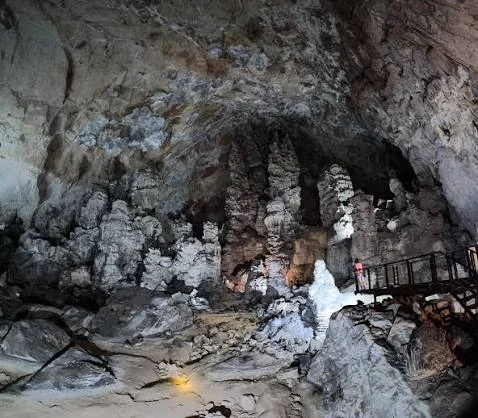
Kong Lor sits inside Phu Hin Bun National Park in Khoun Kham District. Khammouane Tourism describes an underground river of about seven kilometres, while older official Laos tourism material commonly gives roughly 7.5 kilometres and notes passages around 70–80 metres wide with chambers reaching close to 100 metres high. The exact number matters less than the physical idea: a working river crosses an entire limestone massif in darkness. Local boats have long connected communities on opposite sides of the mountain, and the cave was a transit route before it became a famous stop on the Thakhek Loop. During the visitor trip, daylight disappears quickly, the boat runs by headlamp through large black chambers and a developed lit section allows you to step out and walk among formations before continuing toward the far opening.
Think of Kong Lor as a river crossing through a mountain, not a chamber you enter and leave from the same doorway.
02 · THE BOAT
Water level changes the experience more than the timetable does
Small motorised longboats are the core of the visit. In normal conditions the return journey takes around two hours, but recent travellers report two and a half hours or more once boarding, the formation walk and the pause on the far side are included. In the late dry season the Hin Boun can become shallow enough that passengers step out while the boatman drags or pushes the boat over gravel or small rapids. Higher water removes some of those shallow sections but changes the current and the operating margin. Wear footwear that can get wet, keep your life jacket on and protect electronics. A headlamp is useful even where one is provided because most of the cave remains genuinely dark outside the developed lit stop.
A shallow section is not a delay in the experience. It is the river showing you its season.

03 · THE LOOP
Kong Lor deserves to be the destination of the day, not its final checkbox
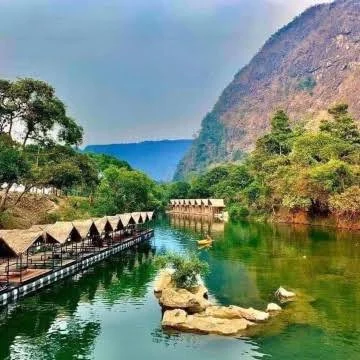
Most travellers reach Kong Lor as the western climax of the Thakhek Loop rather than as a quick excursion directly from Thakhek. The provincial tourism office currently lists the cave about 198 kilometres from Thakhek town. Ban Nahin or Khoun Kham on Route 8 is the practical gateway, with the final road continuing through the limestone valley toward Kong Lor village. Staying near the cave removes the pressure to race the loop before dark and lets you visit early or later in the day. Recent 2025 travel accounts consistently describe the surrounding valley, river and quiet roads as worth more than a single overnight. If you are not riding the loop, public and private transport can reach the area, but schedules change enough that current local confirmation is more useful than an old backpacker timetable.
Follow the Hin Boun through the mountain. The darkness, the shallow water and the far valley are one journey.
.jpg?width=1600)
04 · SEASON & SAFETY
The dry season is easier, but the river always makes the final decision
The river changes the mechanics of the visit by season. From November to April, official Khammouane guidance describes clearer water and safer levels, but late in the dry season the channel can become shallow enough that the boat scrapes gravel or needs to be pushed over small rapids. That is why wet footwear is more useful than perfect trekking shoes you are afraid to soak. In the rainy period from May to October the valley becomes greener and the river rises, but higher water can alter boat conditions and operating decisions. Keep the life jacket on, use the boatman’s instructions rather than deciding where to step, and protect your phone or camera in something waterproof. The cave is enormous enough that a normal phone torch does not explain the space; a proper headlamp helps you understand how much darkness exists beyond the boat’s narrow beam.
FIELD NOTE · BEFORE YOU LEAVE
What matters more than another pin
Kong Lor is a river crossing through a limestone mountain: about seven kilometres of darkness, shallow water, huge chambers and a second valley on the far side make the boat journey one continuous piece of the Thakhek Loop rather than a normal in-and-out cave stop.
Kong Lor is often described as the climax of the Thakhek Loop, but its importance is older than the backpacker circuit. The Nam Hin Boun made the cave a natural passage between communities on opposite sides of the mountain, and Khammouane Tourism notes that villagers used small boats through the cave to move goods and visit one another. That history changes the way the visit reads: the boat is not a theme-park device invented for tourists but the modern version of a route through the karst. Tourism now supports local boatmen and guides, so the cave is also part of the village economy. The best version of the visit keeps both ideas visible at once — a spectacular geological tunnel and a local river route that existed before the Loop put it on traveller maps.
PLAN THE VISIT
Kong Lor Cave, practically
The useful details in one place before you leave Thakhek.
Underground river
The Nam Hin Boun passes through the limestone mountain for about 7 km; older official Laos tourism material commonly describes the cave as roughly 7.5 km long, with passages around 70–80 m wide in places and major chambers approaching 100 m high.
Ticket & hours
Khammouane Tourism currently lists daily opening hours of 08:00–17:00 and a 2026 foreign visitor entry price of 250,000 kip per person. Fees are explicitly subject to change, so reconfirm at the counter.
Boat journey
The standard visit uses a small motorised longboat through the cave and back. Around 2 hours is a useful minimum for the crossing itself; allow 2–3 hours overall for boarding, the lit formation walk, shallow sections and the pause near the far-side valley.
Dry vs wet season
November to April is the official recommended period for clearer water and safer levels. Late dry-season water can become shallow enough that passengers step out while the boat is pushed over gravel or small rapids. May to October is greener but can bring high water and changing boat conditions.
From Thakhek
Kong Lor is normally built into the Thakhek Loop rather than treated as a quick return excursion. Khammouane Tourism lists the cave about 198 km from Thakhek; Ban Nahin / Khoun Kham on Route 8 is the practical gateway before the final valley road to Kong Lor.
What to bring
Wear quick-dry clothing and shoes or sandals that can get wet. Bring a headlamp, protect electronics from water and keep the supplied life jacket on throughout the boat journey. Follow the boat crew when shallow water requires getting out.
QUESTIONS BEFORE GOING
Kong Lor Cave, without the guesswork
Short answers built from the practical field information already attached to this landmark.
Underground river?
The Nam Hin Boun passes through the limestone mountain for about 7 km; older official Laos tourism material commonly describes the cave as roughly 7.5 km long, with passages around 70–80 m wide in places and major chambers approaching 100 m high.
Ticket & hours?
Khammouane Tourism currently lists daily opening hours of 08:00–17:00 and a 2026 foreign visitor entry price of 250,000 kip per person. Fees are explicitly subject to change, so reconfirm at the counter.
Boat journey?
The standard visit uses a small motorised longboat through the cave and back. Around 2 hours is a useful minimum for the crossing itself; allow 2–3 hours overall for boarding, the lit formation walk, shallow sections and the pause near the far-side valley.
Dry vs wet season?
November to April is the official recommended period for clearer water and safer levels. Late dry-season water can become shallow enough that passengers step out while the boat is pushed over gravel or small rapids. May to October is greener but can bring high water and changing boat conditions.
From Thakhek?
Kong Lor is normally built into the Thakhek Loop rather than treated as a quick return excursion. Khammouane Tourism lists the cave about 198 km from Thakhek; Ban Nahin / Khoun Kham on Route 8 is the practical gateway before the final valley road to Kong Lor.
KEEP EXPLORING LAOS
Where does the road go next?
Four other field notes that connect naturally with this part of the trip.

Field note method. Wikipedia is used as a research starting point for history and geography when a relevant article exists. Facts are checked against official, local or specialist sources where possible. Independent travel blogs and field reports are used to identify practical questions, recurring observations and traveller perspective; their wording is not copied.
Sources & photo licences
- OFFICIAL / LOCAL Tourism Laos · Kong Lor Cave
- OFFICIAL / LOCAL Khammouane Tourism · Kong Lor Cave
- FIELD REPORT Asia Safari Laos · Kong Lor Cave · updated 2026
- FIELD REPORT Blog-trotting · Kong Lor traveller report
- FIELD REPORT The Backpacking Wayfarers · Kong Lor traveller report
- IMAGES Wikimedia Commons · Kong Lor Caves photography
- PHOTO Busy · CC BY-SA 3.0 · exact photo source
- PHOTO Jakub Hałun · CC BY-SA 4.0 · exact photo source
- PHOTO Aleksey Gnilenkov · CC BY 2.0 · exact photo source
Photo author, Wikimedia Commons attribution, licence and the exact file source are also shown directly under each Commons image.
KEEP IT IN THE NOTEBOOK
Save Kong Lor Cave for the road.
Add this landmark to your trip now, or open the map when you are ready to work out the route.